
The Psychological Contract in the Workplace: How Mediation and Conflict Management Shape Modern Employee Expectations
Introduction
The relationship between employees and organisations is changing rapidly. Research in employer branding and employee experience suggests that employees increasingly evaluate organisations in ways similar to consumers evaluating brands and services. Employees are more likely to research employers, compare workplace cultures, and assess organisational values, leadership practices, flexibility, and wellbeing before accepting or remaining in a role. This reflects a broader shift in the psychological contract in the workplace, where employees expect greater transparency, fairness, inclusion, and alignment between organisational values and lived workplace experience.
At the same time, the growing use of artificial intelligence (AI), automation, and digital management systems is reshaping workplace culture and employee expectations. While these technologies create opportunities for efficiency and innovation, they also raise important questions about trust, accountability, fairness, and the role of human judgment in increasingly automated workplaces. Employees are becoming more aware of how organisational systems affect their daily experience and are more willing to question practices they perceive as unclear, inconsistent, or unfair.
These changes are also transforming the nature of workplace conflict. Many tensions now emerge not only from interpersonal disagreements, but from unmet expectations, communication breakdowns, and perceived breaches of trust. In this environment, traditional management approaches are often insufficient.
This article explores how mediation and conflict management systems can help organisations respond to these challenges. It examines seven key ways these systems strengthen the modern psychological contract by improving fairness, increasing transparency, clarifying expectations, supporting employee voice, reinforcing inclusion, aligning organisational purpose, and building long-term trust.
The article is particularly relevant for HR professionals, organisational leaders, mediators, employee relations specialists, managers, and researchers interested in the future of work, organisational culture, and the growing strategic importance of conflict management in modern workplaces.
Understanding the psychological contract in the workplace
The psychological contract in the workplace refers to the unwritten expectations between employees and employers. Unlike formal employment contracts, this agreement is based on perceptions, trust, and shared assumptions. Today, this concept is becoming more important than ever as employees evaluate their work experience with the same clarity they apply when purchasing products or services.
Definition and historical evolution
Historically, employment relationships were primarily transactional. Employees provided labour, and organizations provided pay and job security. Over time, especially in knowledge-based economies, this relationship became more relational. Workers began to expect growth opportunities, meaningful work, and respectful treatment.
Now, the psychological contract has evolved again. Employees expect organizations to clearly communicate what they offer from career paths to cultural values. When expectations are not met, frustration and disengagement often follow.
Shift from transactional to relational expectations
Modern workers no longer see employment as just a pay check. They want development, recognition, and fairness. This shift means organizations must actively manage expectations instead of assuming alignment. Mediation and structured conflict management systems are becoming essential tools to support this transformation.
The rise of consumer-like expectations among employees
One of the most significant changes in the modern workplace is the rise of consumer-like expectations among employees. Increasingly, employees approach work in the same way consumers approach brands and services: they expect clarity, responsiveness, fairness, and alignment with their personal values. Employment is no longer viewed simply as an exchange of labour for salary, but as an overall experience shaped by trust, communication, and organizational culture.
Technology has accelerated this shift. Platforms such as LinkedIn, Glassdoor, and social media allow employees to compare workplaces, leadership practices, and employee experiences more easily than ever before. At the same time, AI, hybrid work, and digital communication tools are changing how employees interact with organizations and shaping expectations around flexibility, transparency, and inclusion.
Generational and cultural changes have also influenced what employees value at work. Many employees now place greater importance on purpose, wellbeing, autonomy, and ethical leadership. They expect organizations to communicate openly, involve employees in decision-making, and respond fairly to concerns. As a result, traditional hierarchical management approaches are increasingly challenged in workplaces where participation and transparency are highly valued.
These changing expectations are reshaping the psychological contract in the workplace. Employees are less willing to tolerate unclear communication, inconsistent treatment, or systems they perceive as unfair. Consequently, organizations are under growing pressure to build cultures that support trust, dialogue, and accountability.
Workplace as an experience economy
The modern workplace is increasingly shaped by the principles of the experience economy, where employees evaluate work not only through salary or job security, but through the overall quality of their workplace experience. Employees now expect transparency, flexibility, inclusion, meaningful work, and respectful communication in the same way consumers expect responsive and value-driven service from brands.
This shift has been accelerated by AI, digital technologies, and hybrid work, which have changed how employees interact with organizations and how workplace culture is experienced. Employees increasingly expect organizational systems and leadership practices to be fair, transparent, and responsive. Work is no longer viewed solely as a transactional relationship, but as an experience that should support both professional contribution and personal wellbeing.
As employee expectations evolve, workplace experience has become closely linked to trust, engagement, and organizational reputation. Poor communication, inconsistent management, or unresolved conflict can quickly damage employee confidence and culture.
In this context, mediation and conflict management systems play an important role in shaping positive workplace experiences. By supporting communication, fairness, and psychological safety, these systems help organizations build trust and maintain stronger workplace relationships in increasingly complex and rapidly changing environments.
Demand for clarity and value exchange
Employees want answers to simple but powerful questions:
- What am I expected to deliver?
- How will success be measured?
- What support will I receive?
- Is the process fair?
When these questions remain unanswered, misunderstandings grow. Mediation helps organizations create safe channels to clarify expectations before conflict escalates.
The five non-negotiables shaping modern work
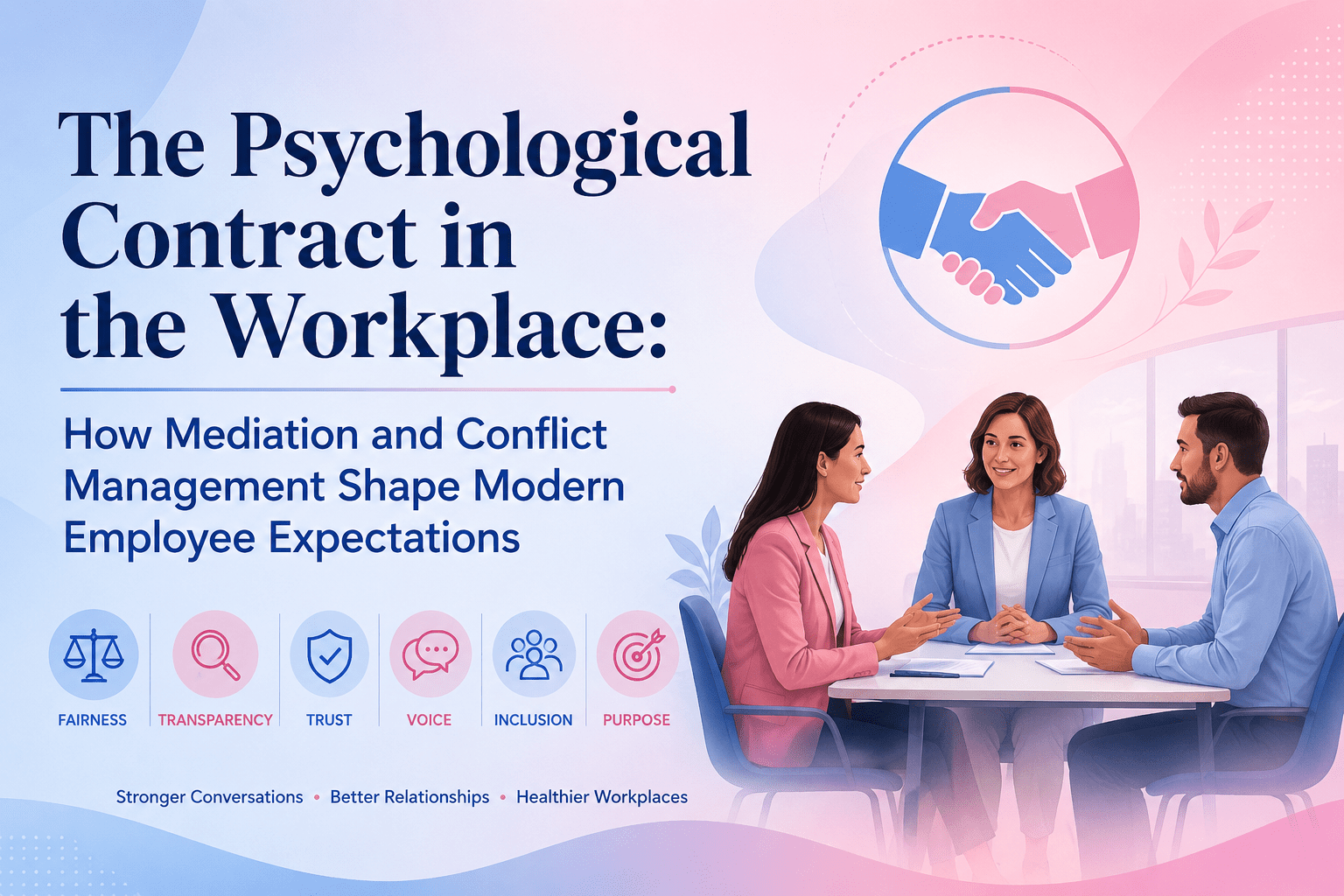
The modern employment relationship is increasingly shaped by five non-negotiable expectations: fairness, transparency, purpose, voice, and inclusion. These expectations now sit at the centre of the psychological contract between employees and organizations. Employees no longer judge work only by pay, status, or job security; they also assess whether the organization treats people consistently, communicates honestly, reflects meaningful values, listens to employees, and creates a genuine sense of belonging.
- Fairness is one of the strongest foundations of trust. Employees expect decisions about pay, promotion, workload, performance, flexibility, and opportunity to be handled consistently and without bias. When fairness is absent, employees may perceive the organization as unreliable or self-serving, even if formal policies appear adequate.
- Transparency has also become essential. Employees want to understand how and why decisions are made, particularly in areas affected by AI, restructuring, performance management, or organizational change. A lack of transparency can create suspicion, rumours, and resistance, while clear communication helps employees make sense of uncertainty.
- Purpose reflects the growing expectation that work should have meaning beyond financial reward. Employees increasingly want to know how their role contributes to wider organizational, social, or ethical goals. When purpose is clearly communicated, employees are more likely to feel motivated and connected to their work.
- Voice refers to employees’ ability to raise concerns, offer ideas, and influence decisions that affect them. Modern employees expect dialogue rather than one-way instruction. When voice is ignored, frustration often grows quietly until it becomes disengagement or conflict.
- Inclusion means employees feel respected, valued, and able to participate fully regardless of background, role, identity, or working arrangement. It is not enough for organizations to promote diversity; employees must experience belonging in everyday interactions, decisions, and opportunities.
Together, these five expectations shape how employees evaluate the workplace. They also explain why mediation and conflict management systems are increasingly important. These systems provide structured ways to address concerns, clarify misunderstandings, support employee voice, and rebuild trust when expectations are not met.
Why expectation gaps create workplace conflict
Expectation gaps arise when employees and organizations hold different assumptions about what should happen at work. These gaps often develop quietly because many expectations are not written into formal contracts. Instead, they sit within the psychological contract: the unwritten understanding of fairness, support, recognition, development, communication, and trust.
Conflict often begins when employees believe the organization has promised, implied, or encouraged something that is not delivered. For example, an employee may expect flexibility, career progression, meaningful consultation, or transparent decision-making, while the organization may assume that its policies or business needs are already clear. When these assumptions are not openly discussed, frustration can build.
In modern workplaces, expectation gaps are becoming more common because work is changing quickly. AI, hybrid work, digital monitoring, restructuring, and changing cultural values all create new questions about fairness, autonomy, inclusion, and accountability. Employees may expect greater transparency about how technology is used, how decisions are made, or how performance is assessed. If organizations fail to explain these changes clearly, employees may interpret silence as unfairness or mistrust.
These gaps can also create conflict because they affect identity and belonging. When employees feel excluded from decisions, overlooked for opportunities, or treated inconsistently, the issue is not only practical; it becomes personal. They may begin to question whether the organization values them, respects them, or acts in line with its stated values.
Mediation and conflict management systems help address these gaps before they escalate. They create structured spaces where expectations can be clarified, assumptions tested, and misunderstandings resolved. By encouraging dialogue, these systems help organizations move conflict away from blame and toward shared understanding, repair, and practical agreement.
The strategic role of mediation in organizations
Mediation plays a strategic role in modern organisations because it helps manage conflict before it becomes damaging, formal, or costly. Rather than treating conflict as an individual problem or a failure of management, mediation recognises conflict as a natural part of organisational life. When managed well, it can reveal expectation gaps, communication problems, cultural tensions, and areas where trust has weakened.
In the context of the modern psychological contract, mediation is especially important. Employees increasingly expect fairness, transparency, voice, inclusion, and respect. When these expectations are not met, workplace tensions can escalate quickly. Mediation provides a structured and confidential process through which employees and managers can discuss concerns openly, clarify assumptions, and work toward practical solutions.
Its strategic value lies in early intervention. Many workplace disputes begin as small misunderstandings or unresolved frustrations. Without a safe process for dialogue, these issues can develop into grievances, complaints, absenteeism, disengagement, or turnover. Mediation allows organisations to address concerns at an earlier stage, often preserving working relationships and reducing the need for formal procedures.
Mediation also strengthens organisational trust. When employees see that concerns are taken seriously and handled fairly, they are more likely to believe that the organisation is committed to accountability and respect. This is particularly important in workplaces affected by AI, restructuring, hybrid work, or cultural change, where uncertainty can increase anxiety and suspicion.
Beyond resolving individual disputes, mediation can also provide valuable organisational insight. Patterns in mediated issues may reveal wider problems, such as unclear policies, inconsistent leadership, poor communication, or exclusionary practices. In this sense, mediation supports learning and improvement, not just resolution.
Ultimately, mediation should be understood as more than a dispute resolution tool. It is a strategic mechanism for protecting relationships, managing expectations, supporting psychological safety, and sustaining a healthier organisational culture.
How mediation strengthens fairness and transparency
Mediation strengthens fairness and transparency by providing a structured and neutral process for addressing workplace concerns. Employees are often more willing to accept outcomes when they believe the process has been fair, respectful, and open.
Through mediation, both parties have the opportunity to explain their perspectives, clarify misunderstandings, and discuss concerns in a balanced environment. This helps reduce perceptions of bias and improves procedural fairness.
Mediation also encourages transparent communication by bringing hidden assumptions and unclear expectations into the discussion. Employees gain a better understanding of how decisions were made, while managers gain insight into how those decisions were experienced.
For organisations, mediation can reveal wider issues such as inconsistent communication, unclear policies, or perceived unfairness. In this way, mediation supports not only dispute resolution, but also stronger trust, accountability, and organisational learning.
Neutral processes and perceived justice
Neutral processes are central to perceived justice in workplace conflict. Employees are more likely to trust a resolution process when they believe it is balanced, consistent, and free from bias. In mediation, neutrality means the mediator does not take sides, make assumptions, or impose a decision. Instead, they create a fair space where each person can explain their perspective and be listened to respectfully.
This matters because workplace conflict is often shaped by perception. Employees may not only question what decision was made, but whether the process leading to that decision was fair. If they feel ignored, judged, or excluded, they may experience the outcome as unjust even if the organisation followed formal rules.
A neutral mediation process helps address this by giving all parties equal opportunity to speak, respond, and clarify misunderstandings. It also reduces power imbalances, particularly where conflict involves a manager and employee. When people feel that their concerns have been genuinely heard, they are more likely to accept the outcome and remain engaged.
Perceived justice is therefore not only about reaching agreement. It is about ensuring that the process feels fair, transparent, and respectful. This strengthens trust in the organisation and helps protect the psychological contract between employees and employers.
Organizational benefits of proactive conflict systems
Proactive conflict systems help organisations address workplace tensions before they escalate into formal disputes, grievances, absenteeism, or employee turnover. Instead of waiting until relationships have broken down, these systems create early opportunities for dialogue, clarification, and resolution. This makes conflict easier to manage and less damaging to workplace culture.
One major benefit is improved trust. When employees know there are fair and accessible ways to raise concerns, they are more likely to believe the organisation takes accountability seriously. This strengthens psychological safety and encourages employees to speak up before problems become entrenched.
Proactive systems also improve organisational learning. Patterns in conflict can reveal wider issues such as unclear policies, inconsistent management, poor communication, workload pressures, or exclusionary practices. By identifying these themes early, organisations can address root causes rather than repeatedly managing the same disputes.
There are also practical benefits. Effective conflict systems can reduce the time, cost, and emotional strain associated with formal procedures. They help preserve working relationships, support engagement, and reduce disruption to productivity.
Most importantly, proactive conflict management supports a healthier psychological contract. It shows employees that fairness, transparency, voice, and inclusion are not only stated values, but practices embedded in the way the organisation responds to concerns.
Conclusion
As the workplace continues to evolve, the psychological contract between employees and organisations is becoming increasingly shaped by expectations of fairness, transparency, inclusion, voice, and purpose. The rise of AI, hybrid working, and changing workplace cultures has created new opportunities, but also new tensions around trust, communication, and accountability. In this environment, organisations can no longer rely solely on traditional management approaches to maintain engagement and healthy working relationships.
Mediation and proactive conflict management systems provide organisations with practical and strategic ways to respond to these challenges. By creating safe spaces for dialogue, addressing concerns early, and strengthening procedural fairness, these systems help organisations manage expectations, rebuild trust, and create more resilient workplace cultures. Importantly, they support not only conflict resolution, but also long-term organisational learning, employee wellbeing, and sustainable performance.
For organisations seeking to strengthen workplace relationships and navigate the changing world of work more effectively, investing in mediation and conflict management is no longer optional it is increasingly essential.
To learn more about how Minute Mediation can support your organisation through mediation services, conflict management strategies, and tailored workplace training, please contact our team for further guidance and support.
WHO ARE MINUTE MEDIATION?
Transform Conflict into Collaboration
Conflict in the workplace or community can be stressful and disruptive. Fortunately, mediation has emerged as a powerful tool for resolving disputes effectively. If you find yourself in a conflict situation, don’t worry Minute Mediation Ltd is here to help.
Our team, led by Avinder Laroya, a Senior Consultant Solicitor, Mediator, Arbitrator, Conflict coach, mental health first aider and expert in International Dispute Resolution, specializes in facilitating disputes and guiding parties to find the best possible solutions.
Ready to move forward and resolve your conflicts?
If you enjoyed this article, subscribe to our newsletter for more insights and tips on conflict resolution.
So what is the wait for?
Book Your Free Consultation Today!
Get in touch with us because every minute counts!
Click here for a free 15 minute consultation.